

A Monmouth County client regained measurable strength within 30 days after trainers Sammy and Danielle designed an injury-adaptive program that restored progressive overload without aggravating old damage.
Sammy Gunz Personal Training builds every program around the individual’s physical history — not a template.
Experienced lifters who train alone and plateau often lack the external coaching structure to program safely around prior injuries, so stalled progress becomes the default rather than the exception.
A specific kind of frustration builds when a lifter knows what their body once could handle, but old injuries won’t cooperate. The weights stop moving. The motivation erodes.
The nagging joint and soft-tissue limitations that have accumulated over years of unsupervised training start dictating every exercise selection — and nobody is watching when compensatory movement patterns start creeping in around old injury sites.
The Monmouth County client who came to Sammy Gunz described the situation precisely: someone “seasoned and struggling to put more weight on the bar.” Not a beginner looking for orientation — an experienced lifter who had hit a ceiling that solo training couldn’t break through.
The intensity had dropped. The structure had fallen apart. No one was there to course-correct when form degraded under fatigue.
The client wasn’t looking for a cheerleader. A coaching team that understood how to program around physical limitations without treating those limitations as permanent roadblocks — that was the actual need.
The coaching team conducted a comprehensive injury history assessment during the initial session before prescribing a single exercise, so the resulting program addressed the client’s actual movement limitations rather than relying on generic programming assumptions.
The first session wasn’t a workout. Co-owners Sammy and Danielle sat down with the client to map a full injury history — not a surface-level “where does it hurt” conversation, but a detailed review of which movements triggered discomfort, which joints had lost range of motion, and which compensation patterns had become habits.
The one-on-one program operates this way for every client: assessment first, programming second.
From that intake, the coaching team designed a periodized strength program with two non-negotiable priorities. First, exercise selection that worked around the client’s specific injury history — substituting movements, adjusting angles, and modifying loading patterns so that progress never came at the cost of re-injury.
Second, a structured progressive overload that systematically added weight to the bar on a timeline that the client’s body could sustain.
Sammy and Danielle coached every rep. The accountability framework that comes with training in a private studio rather than a commercial gym floor meant the motivational gaps that had plagued solo training simply didn’t have room to resurface.
The client reported restored workout intensity and progressive increases in strength within the first month of supervised training — a direct result of structured programming that matched load to capacity.
The shift happened fast. Within 30 days, the client reported something absent for months — genuine forward momentum in the gym.
The weights moved again. The program made sense. Workouts felt like progress rather than damage control, so the client showed up consistently rather than cycling through periods of low motivation.
In the client’s own words:
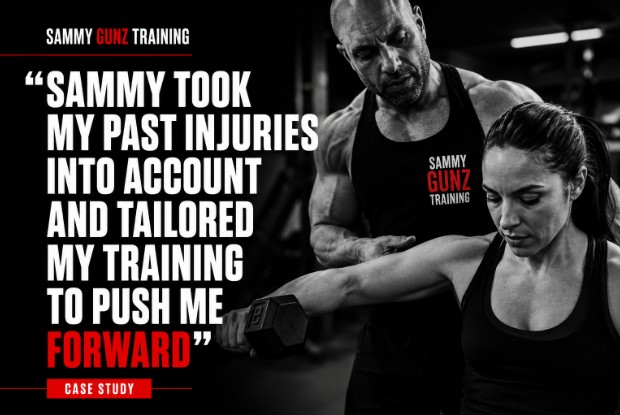
“I was struggling with keeping motivation and intensity in my workouts alone before signing up, but now I feel renewed again. Whether you’re looking to start getting healthier or you’re seasoned and struggling to put more weight on the bar, Sammy took my goals and past injuries into account and tailored my training specifically to help push me forward. Definitely recommend to anyone looking to change for the better.”
The word “renewed” carries weight here. A stalled intermediate lifter with injury constraints requires fundamentally different programming than a first-timer — periodization, load management, and an understanding of training plateaus that the coaching team brings to every client engagement.
The client’s 30-day turnaround reflects that caliber of programming precision.
Solo workout plateaus paired with nagging injuries rarely resolve without external coaching intervention, so the longer a lifter waits to address compensatory patterns, the harder the correction becomes.
If you’ve been grinding through solo workouts that stopped producing results months ago — or if old injuries have quietly narrowed your exercise selection to the point where every session feels like a compromise — that pattern breaks when a coach with the right experience looks at your specific history, builds a program that accounts for it, and holds you accountable to a progression strategy your body can actually follow.
The coaching team at Sammy Gunz in Monmouth County specializes in exactly that scenario. You can read what other clients have experienced on the testimonials page or review common training questions.
When you’re ready to stop training around the problem and start training through it, reach out directly — the assessment conversation is where everything starts.
Can a personal trainer help if you have old injuries that limit your workouts?
A qualified personal trainer conducts a full injury-history assessment before prescribing exercises, then selects movement substitutions, modified loading angles, and adjusted rep ranges that allow progressive strength gains without aggravating existing joint or soft-tissue damage. The programming adapts to the individual’s physical history.
How long does it take to see results with a personal trainer in Monmouth County, NJ?
Clients at Sammy Gunz Personal Training have reported renewed motivation to work out and measurable strength gains within 30 days of starting a supervised one-on-one program. Results depend on training frequency, injury severity, and adherence to the individualized program the coaching team designs during intake.
What is progressive overload, and why does it matter for strength training?
Progressive overload is the systematic increase of training stimulus — through added weight, volume, or intensity — applied across a structured timeline. The American College of Sports Medicine identifies progressive overload as the foundational principle for muscular strength adaptation in resistance training programs for all experience levels.
How does Sammy Gunz Training design programs for clients with past injuries?
The coaching team conducts a detailed first-session assessment covering injury history, range-of-motion limitations, and compensatory movement habits. Trainers Sammy and Danielle then built a periodized program with exercise substitutions and modified loading patterns that protect vulnerable joints while driving measurable strength improvement.
Why does training alone in a gym eventually stop producing results?
Solo lifters lack external feedback on form degradation, compensatory patterns, and programming periodization. Without a coach adjusting load, volume, and exercise selection based on observed performance, most self-directed programs plateau within months as the body adapts to unchanging stimuli and injuries accumulate from unaddressed technique flaws.
Do the trainers at Sammy Gunz work as a team on individual client programs?
Co-owners Sammy and Danielle collaborate on client program design, combining their respective coaching specialties during the initial assessment and throughout ongoing training. The team-based model means that multiple qualified perspectives inform each client’s exercise selection, load progression, and injury-modification strategy in every session.
What happens during the first training session at Sammy Gunz Personal Training?
The first session is an assessment, not a workout. Trainers review the client’s full injury history, current fitness baseline, movement quality, and specific training goals. The coaching team uses that information to build a periodized program tailored to the client’s body before prescribing a single working set.
Is personal training in Monmouth County worth the investment for experienced lifters?
Experienced lifters who have plateaued benefit from coached training because a qualified trainer identifies the specific programming gaps — stale periodization, accumulated compensatory patterns, and mismanaged training volume — that self-directed athletes cannot diagnose on their own. The investment targets the structural cause of stalled progress.