

The questions below are the ones Monmouth County residents ask most before starting personal training — covering cost, results timelines, nutrition, training science, and how to choose the right format.
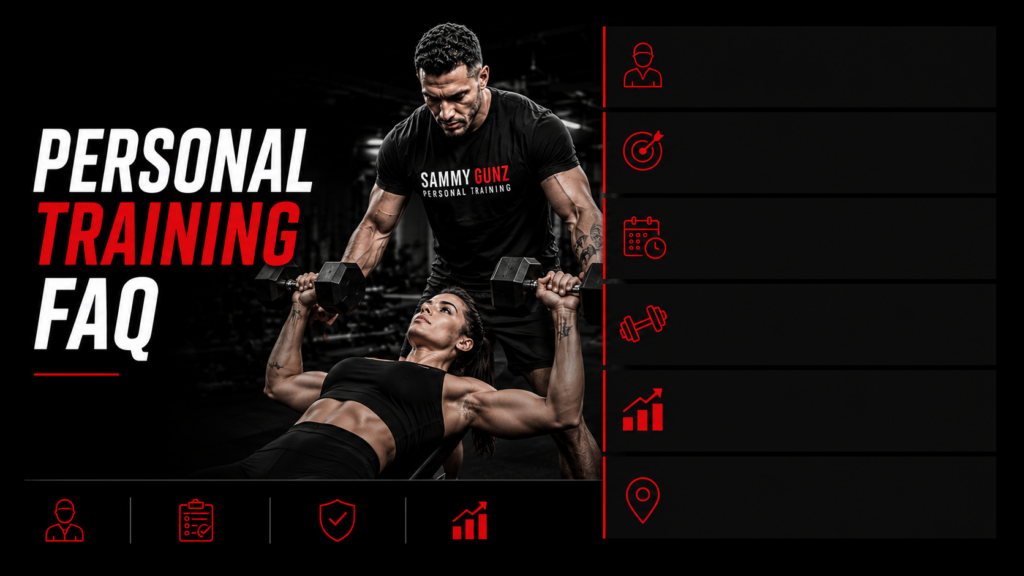
Sam Younesi, owner and head trainer at Sammy Gunz Training in Matawan, NJ, answers each one directly. Clients who want to discuss their specific situation can book a free coaching call before committing to any program.
Is personal training worth the cost in New Jersey? Personal training is worth the cost for clients whose primary goal is a measurable change in body composition — fat loss, muscle gain, or both — and who have not achieved that goal through self-directed gym training. The investment pays off when the trainer delivers program design, real-time form coaching, and accountability that the client cannot replicate independently. Clients who join commercial gyms in Monmouth County without coaching spend less per month but accumulate 12 months of subscriptions without results.
How much does personal training cost in Monmouth County, NJ? The National Academy of Sports Medicine reports that certified personal trainers nationally average $61 per hour for one-on-one sessions. New Jersey ranks third nationally for exercise trainer wages, according to U.S. Bureau of Labor Statistics data as of May 2022, meaning Monmouth County rates typically run above the national average. Adding two coached sessions per week at a commercial gym in New Jersey — on top of the $15-$25 base membership — brings the annual total to over $6,500.
Is a private personal training studio more expensive than a big box gym? A big box gym membership in New Jersey costs $15 to $25 per month. Personal training at that gym adds $61 or more per session on top of the membership fee. A private studio session includes coaching, program design, and nutrition guidance in a single fee — no separate membership required. Clients who compare monthly sticker prices underestimate the actual cost of coached training at a commercial gym versus the all-in pricing structure at a private studio.
How do I know if I need a personal trainer or just a gym membership? A gym membership suits clients who can effectively self-program, perform compound lifts with proper form, consistently apply progressive overload, and manage their own nutrition. A personal trainer suits clients who lack any one of those four elements. Most Monmouth County residents who have held gym memberships without achieving their body composition goals are missing program structure or accountability — both of which a personal trainer provides directly.
Does personal training include nutrition coaching, or is that separate? At most commercial gyms in Monmouth County, personal training and nutrition coaching are separate services billed independently. Sammy Gunz Training integrates nutrition counseling into its training programs — covering customized meal plans, macro tracking, food swap options, and supplementation guidance under a single coaching fee. Clients who want dietary guidance without adding workout sessions can also enroll in nutrition counseling as a standalone service.
How soon will I see results from personal training in Monmouth County? Most clients notice improvements in strength, energy levels, and workout performance within the first two to four weeks — before visible changes in body composition appear. Visible fat loss and muscle definition typically emerge between weeks four and eight for clients training two to three times per week with consistent nutrition. One Sammy Gunz Training client documented losing 10 pounds in three months on a combined exercise and nutrition program under direct coaching supervision.
How long does it take to lose weight with a personal trainer? Clients following a combined resistance training and nutrition program can typically lose one to two pounds per week — the rate most fitness research identifies as sustainable for fat loss without lean muscle loss. Younesi designs both the workout and nutrition components of client programs so caloric targets and training volume align week to week rather than being managed by two separate providers with no coordination between them.
How long does it take to build muscle with a personal trainer? Beginners typically see strength increase 20 to 50 percent within the first eight to twelve weeks of consistent training, with visible muscle definition appearing after eight to twelve weeks of progressive overload paired with adequate protein intake. Experienced lifters progress more gradually. Younesi adjusts load, volume, and exercise selection at the end of each training phase to move the client past the initial adaptation window into continued progress.
How many days a week should I train with a personal trainer? Two to three sessions per week produce measurable body composition results for most clients, according to the American College of Sports Medicine exercise guidelines. Fewer than two sessions per week reduces the progressive overload stimulus needed to drive adaptation. Younesi sets session frequency at intake based on each client’s recovery capacity, fitness history, and whether the client performs additional independent workouts between scheduled sessions at the Matawan studio.
Why am I not seeing results from my personal training sessions? The three most common reasons clients plateau are an insufficient caloric deficit for fat-loss goals, inadequate progressive overload in their exercise program, and inconsistent attendance. Nutrition compliance accounts for the majority of body composition outcomes — clients who train consistently but do not manage their caloric intake stall regardless of training quality. Younesi addresses all three variables simultaneously through combined exercise programming and nutrition counseling rather than treating each as a separate concern.
How do I break through a fitness plateau in Monmouth County? A plateau signals that the current training stimulus no longer exceeds the body’s adaptation threshold. Breaking it requires changing one or more programming variables: increasing load, adding volume, altering exercise selection, adjusting rest intervals, or modifying the training split. Younesi reviews each client’s performance data after each weekly cycle and modifies programming before stagnation extends beyond two weeks — a protocol that prevents the months-long plateaus common in self-directed training at commercial gyms.
Can a complete beginner start personal training in Matawan, NJ? Complete beginners benefit most from personal training because foundational movement patterns — squat, hinge, press, pull, and carry — require supervised instruction to develop safely. Younesi builds beginner programs based on a health and fitness assessment taken during the first session, establishing proper mechanics before adding load or complexity. Beginners at the studio in Matawan train with separate programming from advanced clients and receive the same individual attention as experienced athletes in every session.
Am I too out of shape to start personal training? No fitness level is too low to start personal training. Younesi designs programs for clients who are completely sedentary, overweight, recovering from a training gap, or managing health conditions that require exercise modification. The health and fitness assessment at the first session captures each client’s current capacity, so the program starts at the right intensity — challenging enough to produce adaptation, manageable enough to sustain without injury or excessive soreness.
Can personal training help with injury prevention? Personal training reduces injury risk through three mechanisms: real-time form correction on every repetition, progressive load management that does not advance faster than the client’s tissue can adapt, and movement screening at intake that identifies compensatory patterns before they become injuries. Clients who train at commercial gyms without supervision accumulate technique breakdowns over months without feedback, allowing minor form errors to become chronic overuse injuries that require weeks of rest to resolve.
Can personal training help with weight loss if I am significantly overweight? Resistance training combined with a caloric deficit produces fat loss regardless of starting weight. Younesi pairs exercise programming with nutrition counseling, covering customized meal plans, macro targets, food swap options, and supplementation guidance — addressing both the training stimulus and the dietary side, which accounts for the majority of fat-loss outcomes. Clients who have attempted weight loss through diet alone or through unsupervised cardio without strength training consistently achieve better and more lasting results with combined program support.
Does Sammy Gunz Training work with athletes in Monmouth County? The studio designs sport-specific resistance and conditioning programs for athletes seeking to improve performance. Younesi builds athlete programming around each sport’s specific energy systems, movement demands, and strength-to-weight requirements. Athlete clients at the Matawan studio train with separate programming from general fitness clients — targeting neuromuscular coordination, power output, and position-specific conditioning rather than body composition as the primary outcome.
What should I eat before a personal training session? A small meal or snack containing protein and easily digested carbohydrates consumed 60 to 90 minutes before a session provides sufficient energy for training without causing digestive discomfort during exercise. Clients who train early in the morning with insufficient time for a full meal perform adequately with a small carbohydrate source — a banana or a rice cake — eaten 20 to 30 minutes before the session starts. Younesi covers pre- and post-workout nutrition specifics during the nutrition counseling intake for each client.
What should I eat after a personal training session? A post-workout meal combining protein and carbohydrates, consumed within 60 minutes of the training session’s completion, supports muscle repair and glycogen replenishment. Protein drives muscle protein synthesis, which produces strength and definition gains over time. Clients who train for fat loss should consume a post-workout meal within the caloric targets of their overall daily plan, rather than treating the post-workout window as an excuse to exceed their deficit.
Should I do cardio or strength training first in a session? Performing strength training before cardio in the same session preserves neuromuscular performance for compound lifts — the exercises that drive the largest hormonal and structural adaptations. Cardio performed to exhaustion before strength training degrades force output and increases the risk of form breakdown on heavy lifts. Younesi sequences each client’s session to prioritize the training component that serves their primary goal — strength and body recomposition. Clients perform resistance work first; conditioning-focused athletes may vary the sequence based on sport demands.
Can I spot-reduce fat on my stomach, arms, or thighs? Spot reduction — targeting fat loss in a specific body area through exercises that work that area — does not work. Fat loss occurs systemically throughout the body based on total caloric deficit and training volume, rather than in isolated regions targeted by specific exercises. Clients who want to address the appearance of specific areas achieve results through a combination of overall fat loss and the development of the underlying muscle groups, both of which Younesi programs simultaneously through resistance training and nutrition management.
How important is nutrition compared to exercise for body composition results? Nutrition and exercise both influence body composition, but nutrition accounts for a larger share of fat-loss outcomes. A client who trains three times per week but maintains a caloric surplus will not lose body fat regardless of training quality. A client who maintains a consistent caloric deficit and adequate protein intake will lose fat even with a moderate exercise volume. Younesi addresses both variables through the combined exercise and nutrition counseling program rather than treating them as independent services.
What is the difference between one-on-one and small group personal training in Monmouth County?
One-on-one personal training allocates a single trainer’s full attention to one client for the entire session — every repetition of every set receives direct coaching. Small-group weight training at the studio caps at 4 clients per class and follows a shared workout structure, while Younesi provides individual form coaching to each participant throughout. Both formats differ from commercial gym group classes, which average 15 to 30 participants and cannot provide individual instruction.
Is online fitness coaching effective for weight loss in New Jersey? Online coaching delivers measurable fat-loss results for clients who perform workouts consistently, follow the nutrition plan, and engage in weekly check-ins. The online nutrition and fitness coaching program at the studio covers a customized exercise plan, a personalized meal plan, weekly Zoom or FaceTime check-ins, daily messaging support, progress photo tracking, and supplementation guidance. Clients outside Monmouth County or with schedules that prevent in-person attendance can access the same combined exercise and nutrition programming through the remote format.
What should I look for when choosing a personal trainer in Monmouth County, NJ? Monmouth County residents choosing a personal trainer should evaluate four criteria: whether the trainer builds individualized programs from an assessment rather than applying a standard template, whether nutrition guidance is integrated or available as a separate component, whether the trainer’s coaching structure includes between-session accountability, and whether the facility type — private studio or commercial gym floor — matches the level of supervision the client’s goals require. Client results documented in reviews and before-and-after photos provide the most reliable evidence of a trainer’s effectiveness.
What is HIIT training, and is it effective for fat loss in Monmouth County? High-intensity interval training alternates short bursts of maximum-effort exercise with brief active recovery periods, producing a high caloric burn in a short session window and elevating metabolic rate for hours post-workout. HIIT is one component of the training program at Sammy Gunz Training — combined with strength training, circuit training, and stretching within a structured weekly plan. Younesi programs HIIT based on each client’s conditioning level, recovery capacity, and weekly training schedule rather than applying a fixed protocol regardless of individual readiness.
Should I choose in-person or online personal training in New Jersey? In-person training at the Matawan studio suits clients in Monmouth County who benefit from real-time form coaching on compound lifts, have a schedule that accommodates fixed session times, or are beginners who need hands-on instruction to establish correct movement patterns. The online coaching program suits clients with flexible or unpredictable schedules, clients outside the studio’s commuting distance, and clients with training experience who can execute a program independently with remote accountability and weekly video check-ins.
Still have a question not covered here? Younesi at Sammy Gunz Training answers every question on the free coaching call — book yours today and get a direct answer before making any training decision in Monmouth County.